
- Marriage
Type
In Xizang (Tibet), the marriages are of three types: (1) monogamy (2) `one husband multi-wives' (3) `one wife multi-husbands'. The prevailing marriages are monogamy with `multi-wives' and `multi-husbands' permissible.
- Monogamy
Most marriages are monogamous. Counting in terms of family units, 90 % or more of marriages are monogamous. Due to the limit of the Tibetan houses and the tents, most families are of kernel type, i.e., parents and their offspring. The grandparents rarely live with the grandkids, only 10 % do so. If they do, the older generations may spend their time in worshiping the Buddhas, and preparing for their next reincarnations. Most families are patriarchal. The men usually make the important decisions, buying and selling, paying tributes to the deities, horse racing, hunting etc. The women are the main stay of family life. They are busy from morning till night, milking cows, making tea, roasting and grinding barley, making butter and curd, making clothes and looking after children. The ten years or older kids shepherd, gather yak-dung (as fuel for cooking and heating), fetch water.
- Multi-wives
Many mammals (as against birds) have `one male-many females' reproduction system. It is the male's strategy to have as many female companions as possible. As we know, many culture rules are rooted in the gene. It is a norm in the modern society to have sequential wives and husbands. In many ancient societies, the multi-wives family is recognized. Most Tibetan kings have several wives. Moreover, the number of monks in Xizang (Tibet) in 1949 is about 110,000 in a population of 1,000,000, in other words, 11 % of the total population (with the same proportionality, U.S.A. would have 27 million monks), and 35 % among the males in the marriageable ages. There is a shortage of available males. In many sparsely populated area, it is hard to find a suitable spouse. The peculiar points of Tibetan multi-wives families are: (a) marriage with step-mother, uncle's widow and widowed sister-in-law (b) marriage with wives' sisters (c) marriage with step-daughters.
- The
marriages with step-mother, uncle's widow and widowed sister-in-law
are largely social responsibilities to take care of the hapless
widows, although it does happen when the father is still alive.
- The prevailing
form of multi-wives marriage is the marriage with wife's sisters.
This form of marriage may happen if the husband is married into
the wife's family and her younger sisters grow up and wish to
stay. Then the husband will cohabit with the younger sisters
of his wife.
- This form is similar to the above. A man marries with a widow with young daughters. When the step-daughters grow up, the man has the right to cohabit with them.
- The
marriages with step-mother, uncle's widow and widowed sister-in-law
are largely social responsibilities to take care of the hapless
widows, although it does happen when the father is still alive.
- Multi-husbands
To maintain a household and avoid the dividing of property, sometimes a younger son is sent to the monastery to be a monk, similar to the European custom of giving the younger sons titles of knight without property. For this purpose, after the elder brother marries a girl, and the younger brothers grow up, the wife is shared. Usually, it is considered to be a good indication of the harmony of the brotherhood for them to marry with a single woman. The offspring of the wife will be considered as the offspring of the head husband. Occasionally, the father will join the husband group. Sometimes, the husbands may not be blood-related, while economically related. Usually, the wife will have her own bedroom, and a sign will be posted outside.
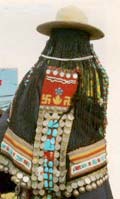 When the girl is 15 or 16 years old, she is initiated to the adulthood by a ceremony.
Her hair will be plaited from a single braid to many braids.
From then on she is considered to be full grown and allowed to have male friends.
- Monogamy
- Marriage Procedure
- Full-Grown
Ceremony
When the girl is 15 or 16 years old, she is initiated to the adulthood by a ceremony. The date is selected to be a lucky day according to the Tibetan calendar. Her hair will be plaited from a single braid to many braids and she will start wearing colourful apron. From then on she is considered to be full grown and allowed to have male friends.
- Romance
All public gatherings, religious festivals, horse racing, are good occasions for boys to meet girls. After worshiping the Buddhas, youngsters gather together to dance and sing. Sometimes, the agreed couples will call friends to have a singing competition around bonfires in the moonlight. The boys and girls routinely date each other, either in one's place or going out all night. At the grassland, the girl may wait for the boy outside the tent while guarding the sheep in the deep night, the boy will bring a piece of meat to silence the dogs, and then they have all the time to themselves.
- Engagement
It is similar to Han's custom. After a romance, the couple may simply ask their parents for permissions to engage, and to marry. The permissions are granted routinely. Then the boy will ask an old gentleman to propose the marriage to the girl's parents. It is usually the couple who selects to join one of the two families or to set up their own household.
Or the parents may arrange the marriage. In this case, the parents will ask an old gentleman to go to the girl's family with a hada and a bottle of barley beer to propose. After the marriage broker enters the house of the girl's family, and presents the hada and the bottle of barley beer, the females will withdraw. The father will either decline the proposal, if the girl is unwilling, or mentions: "According to our tradition, only the maternal uncle of the girl has the right to make this decision." Then the marriage broker will stay overnight to meet the maternal uncle of the girl. The next day, after the marriage broker pleads with the uncle, and if he nods, then the father will open the bottle of barley beer for the uncle, the couple is then considered to be engaged. The boy's family will present suitable gifts to the uncle and the girl's family.
- Wedding
The couple may join either family. The following is a procedure for the girl to marry into the boy's family. If the boy marries to the girl's family, the procedure is identical with the switching of bride and groom.
On the wedding day the groom's house (or tent) will have been refurbished, the bowls painted with eight auspicious emblems ready for use, and a square carpet of white wool laid to welcome guests. The day before, the maternal uncle of the groom goes to bride's house (or tent) taking along as gifts a white horse for the bride to ride on, a bridal gown of white woolen fabric as well as a tea-brick and a large chunk of butter. Two girls from the bride's side will greet the groom's uncle: "Respectful Uncle, please drink the three bowls of delicious beer from us" and so on. The uncle answers and drinks the beer without dismounting the horse, then proceeds to bride's house (or tent). He opens the door with a hada (ceremonial scarf). After presenting the hada to her parents, he chants a blessing to every object inside, stove, chairs etc. The next day, the bride puts on the bridal gown and rides the white horse to groom's house (or tent) in the company of her uncle and his uncle. His uncle rides ahead to announce the arrival of the bride. Two girls from the side of the groom will offer her uncle barley beer and sing in antiphony with him. In the meantime, the bride will dismount in front of the house (or tent), and step exactly in the middle of the white mat where there is a emblem formed from grains of barley. When the bride's uncle and the two girls have sung long enough, the groom's family will ask him to dismount and come in.
Likewise, the bride's uncle open the door with a hada. Once inside, they exchange hadas and chant blessings. Then the groom's uncle formally open the wedding.
The groom and the bride will kneel down in front of the parents of the groom and the picture of Buddha while the monks chant. Then the bride will use her ring finger to flip milk-tea three times to salute the heaven, earth, Buddhas. After these, the bride will serve milk-tea to the parents of the groom.
The wedding feast will then start. A master of ceremony, `nianbo', will manage the banquet which is interrupted by many presentations of hadas, blessings and gifts. Sometimes the groom and the bride are nearly buried beneath the large number of hadas tied around their necks.
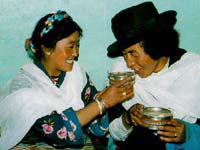
The bride and groom are exchanging their barley beer drinks.
- Full-Grown
Ceremony
- Marriage Rule
- Incest
In Xizang (Tibet), cases of incest, which is strictly defined by blood-relation only, and which has nothing to do with marriage-relation, are very rare. If in doubt, an investigation of `checking the bone' will be launched. Sometimes, it is checked up to 12 lineages. Sometimes, only the male lineage is checked, and nothing about mother-sides. In some places, the `(maternal) aunt-nephew' marriage is idealized. The penalties for the wrong-doers used to be very severe. When a person is found guilty of incest, he or she is wrapped in a raw hide sprinkled with salt and then thrown into a river.
- Child Support
It is strictly prohibited to make romantic adventure towards an underage girl. It is not uncommon to have children out of wedlock. Child-supports are required. However, the child-support is very little, moreover, in the grassland, sometimes the children are sired by nameless travelers at those one night stands, and the fathers are nowhere to be found. In most places, `illegitimate child' will not be discriminated against and follows the mother to her marriage, and in some places, the child will be called `dirty kid' and be looked down upon.
- Divorce and
remarriage
There are some sex freedom after the wedding, and marriage sometimes breaks down. Divorce is not uncommon, and remarriage is not discriminated against after divorce.
- Incest
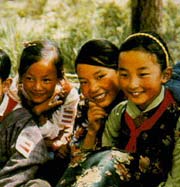
A group of pupils in an elementary school.