- Introduction
 The
traditional Tibetan houses of agriculture and pastoral areas are different:
in the agriculture area, people live in the houses constructed with
wood and stones, in the pastoral area, people live in tents mainly.
We will separate our discussions accordingly. The
traditional Tibetan houses of agriculture and pastoral areas are different:
in the agriculture area, people live in the houses constructed with
wood and stones, in the pastoral area, people live in tents mainly.
We will separate our discussions accordingly.
- House
Depending on the availability of the materials, the Tibetan houses are
built with more woods, for those living near forest, or more stones,
for those living near mountains. Usually, the walls are one meter thick
and built with stones. The roof is built with scores tree trunks, and
then covered with a thick layer of clay. When it is finished, the roof
is flat.
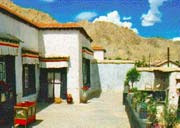
 In
the valley area, the whole structure is like a castle with small windows
as big as gun holes. No doubt, this is for defense purpose. In the city,
there are big windows facing south to let sun light in. The houses are
either one or two, three, four story high. For one flat house, sometimes
a guarding wall is built around to keep the animal in and outsiders
out. For a three story high house, the lowest level is a barn for animals
or a storage place. The second story is the living quarter for human
beings. The third story is the worshiping hall or sometimes the grain
bin. The stairs are outside the house and usually made of single tree
trunk from roof to roof. Once the ladders are withdrawn, the higher
levels become inaccessible. In
the valley area, the whole structure is like a castle with small windows
as big as gun holes. No doubt, this is for defense purpose. In the city,
there are big windows facing south to let sun light in. The houses are
either one or two, three, four story high. For one flat house, sometimes
a guarding wall is built around to keep the animal in and outsiders
out. For a three story high house, the lowest level is a barn for animals
or a storage place. The second story is the living quarter for human
beings. The third story is the worshiping hall or sometimes the grain
bin. The stairs are outside the house and usually made of single tree
trunk from roof to roof. Once the ladders are withdrawn, the higher
levels become inaccessible.
Inside the living quarter, there are kitchen, living rooms. There are
fireplaces and stoves in the kitchen. The common fuels are wood and
dung. The furniture are painted in bright colours. The lavatory is usually
at the highest part of the house as an extension. This way, the house
is clear of the smell.
- Tent
The pastoral people sometimes build houses as home bases for the old
folks and for storage. They usually enjoy a life of nomad and live in
the tents. There are two kinds of tents in the pastoral area: black
yak wool tents and white cloth tents.
- Black Yak Wool
Tent
To make black yak wool tent, people use yak wool to make big ropes
first, and then tie the ropes together. For a good size tent, which
covers 300 square ft, it requires about 200 lb wool. The tent is
square at the base with a window at the top which let smoke out
and sun light in. In a snowy day, the window can be shut.
The front part of the tent is split into two pieces to make a door.
There is nether bed, nor chair inside a tent. People sit on carpets
and cushions. At the middle of the tent, an earthy fireplace is
set up. Behind the fireplace, there are fuels (yak dung). The tent
is naturally divided into two quarters. Man occupies the left half,
and woman the right half. The inner part of the left side is the
worshiping place equipped with Buddha statue, scripts, lamps. The
right side is for utensils and food storage.
Outside the tent, sometimes people build a wall of sod or dung to
guard the animals or protect them against cold wind.
- White Cloth
Tent
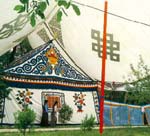
Usually, the pastoral people have a couple white cloth tents. These
tents are smaller and elegant, good for traveling. In a religious
or racing gathering, people come with white cloth tents. The elders,
teens, and guests usually stay in this kind tents. The fireplace
is usually outside the tent. There are big hexagonal tents well
decorated with religious signs, mainly around monasteries or for
the use of religious occasions.
Back
to top
|
