- Introduction
Due to the high altitude of Xizang (Tibet), the water boils at 90 degree Celsius,
and cooking with water is impossible. The diet and foods are peculiar
in Xizang (Tibet). The Tibetan diet consists mostly of meat, milks and
other high-protein foods. The main staple is `tsamba'. Tea is a necessary.
Travelers usually bring dried meat, tsamba, and tea for foods. Recently,
after the introduction of pressure cooker, there are more varieties,
some are imitations of Han cooking ("Chinese food" in the West). At
the end of this article, we will provide the menu of a Tibetan restaurant.
|
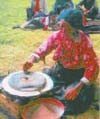 Tsamba
is made of roasted barley (with husk) ground with a hand mill
into very fine flour, which is mixed with a little tea and then
rolled into small lumps and eaten with fingers. Butter, curds
and sugar add flavour. Tsamba
is made of roasted barley (with husk) ground with a hand mill
into very fine flour, which is mixed with a little tea and then
rolled into small lumps and eaten with fingers. Butter, curds
and sugar add flavour.
|
- Meat
- (1) Dried Meat
In the winter, beef and mutton are cut into long stripes to be air-dried
in the circular ground caves or bins walled with stones or dung.
Dried beef and mutton keep better and longer, as the bacteria in
them are killed during the drying process in deep winter. Dried
meat also packs well. In the next year, the dried meat will be Bar-B-Qed
or be eaten raw.
- Finger Meat
Big chucks of fresh meat are boiled in a pot. Salt, ginger, spices
are added. The meat is served when it changes colour. People take
the meat by hands and cut them with the carried knives. The breasts
and spareribs are for the guests. The tails of white sheep are for
the guests of honor. If a young man is treated with a tail of white
sheep in his girl friend's house, it implies that he can hope.
- Sausage There
are four different sausages in Tibet: blood, meat, flour and liver.
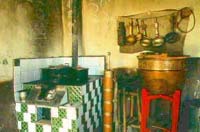
A modern Tibetan kitchen of a residence. The stove
is about 60% efficient.
Some houses use sun-furnace to boil water.
- Dairy
Milk is drunk fresh or made yogurt, or is separated by churning into
butter and curds.
- Butter
The Tibetan butter is home-made and can be further processed and
refined into butter known elsewhere. Butter is used for food with
`tsamba', tea etc., or for the fuel of lamp.
- Curd
After butter is made from milk, the remainer becomes sour and can
be made curd. Milk curd placed in the mouth and sucked on helps
to quench thirst and can be mixed with barley flour to make curd-pastry,
a holiday delight.
- Yogurt
The milk is boiled first, after removed from stove, some old yogurt
is added. Yogurt will form in a few hours. In the central and western
parts, the yogurt is thin and smooth. In the east, it is too thick
to stir. Yogurt is mentioned in the famous poem `the story of Gesar',
and has been a Tibetan food for more than 1,000 years.
|
 Tsamba
is made of roasted barley (with husk) ground with a hand mill
into very fine flour, which is mixed with a little tea and then
rolled into small lumps and eaten with fingers. Butter, curds
and sugar add flavour. Tsamba
is made of roasted barley (with husk) ground with a hand mill
into very fine flour, which is mixed with a little tea and then
rolled into small lumps and eaten with fingers. Butter, curds
and sugar add flavour.
|
- Staple
The main staple food is `tsamba'. This is made of roasted barley (with
husk) ground with a hand mill into very fine flour, which is mixed with
a little tea and then rolled into small lumps and eaten with fingers.
Butter, curds and sugar add flavour.
`Tubo', a savoury evening gruel made of lumps of wheat flour, tsamba,
dried meat and a tuber called `yuangen'.
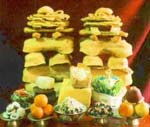
These are holiday delights, curd-pastries and some
fruits.
- Tea
There are three ways to make tea: simple tea, milk tea and butter tea.
The most common tea leaves are produced in the Han Land, as Fu Tea from
Hunan, Tou Tea from Yunnnan and Ta Tea from Szechuan. Tibetan tea-drinking
forms a special `tea culture'.
Simple tea is boiled tea without any additive. Milk tea is also called
sweet tea. It is an imitation of English tea and Indian tea. However,
tea, milk and sugar are boiled simultaneously, which gives it a distinct
flavour.
To make butter tea, a Tibetan specialty, you put hot boiled tea and
a dash of salt into a tall and slender churn, add a pat of butter, stir
the mixture heavily until the tea and butter are well blended and ready
to serve. Many non-natives find the taste of this tea a bit rank, but
supposedly, once hooked, to go without it causes backaches.
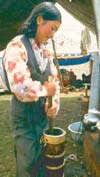
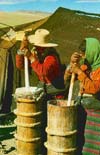
A Tibetan modern female stirs (or beats) the mixture of tea,
salt and butter heavily until the tea and butter are well blended
and ready to serve.
- Barley Beer
It is made of barley, slightly sour, resembles beer. It is a must in
the weddings and the funerals.
- Menu of a modern
restaurant
A guest will select from each of the following six groups:
- Butter tea.
- Cold dishes:
yak stomach, air-dried beef, mutton sausage, blood sausage, Xigatse
starch sheet, curd, curd pastry.
- Hot dishes: stir
fried sheep lung, beef stew with turnip, ox-foot stew Han-style, steam
wild duck with insect-plant, beef and potato with curry sauce. finger
mutton, braised ox tender, boiled mushroom.
- Staple: rice
with butter, flour lump with butter and curd, tsamba cake with curd,
beef dumpling, curd pastry, mou-mou (steam bread, a Norther Chinese
food).
- Beverage: barley
beer, beer, Tibetan vodka, mineral water, soda.
- After dinner
drink: simple tea, milk tea, butter tea.
Back
to top
|
