
- Introduction
 In
the modern Xizang (Tibet), some people wear the Western dresses as Han people
do. Some Tibetan cadets wear the standard Chinese cadet's dresses. In
the Xizang (Tibet) Autonomous Region, 95 percent of the populations are Tibetans,
the rests are Hans, Moslems, Menbas, Lobas, Drungs, Xiaerb as and others.
In this short article we will describe the traditional Tibetan dresses.
In
the modern Xizang (Tibet), some people wear the Western dresses as Han people
do. Some Tibetan cadets wear the standard Chinese cadet's dresses. In
the Xizang (Tibet) Autonomous Region, 95 percent of the populations are Tibetans,
the rests are Hans, Moslems, Menbas, Lobas, Drungs, Xiaerb as and others.
In this short article we will describe the traditional Tibetan dresses.
-
Robe And Belt
A typical Tibetan clothes is made of sheepskin or wool. It is usually home-made by man. In the agriculture area the wool will be made `pulu' first. Then the `pulu' or sheepskin will be made into a gown with cloth or silk exterior cover called `qugba". In the grassland, sheepskin is common. A sheepskin will be sun baked and then cleaned. It will be soaked for a few days in the liquid of milk after butter is extracted. Then it is ready for men to tailor.
The Tibetan robes, which serve as blankets at night, are very long and are worn down to the knees with the extra length tucked and held up by a waistband or belt. The robe produces two large pockets, one in front and another at the back, for people to carry things, including baby. When it is hot in the daytime, Tibetans will undress the right arms to disperse heat. If it is even hotter, then one may undress both arms and tie the sleeves around the waist.
For a good clothes, the collar and hem are made of special materials. For man, the collar is sometimes made of leopard belt, fox belt. For woman, the collar is made of red cloth or several strips of bright coloured cloths or corduroies. For hem, otter belt and silk will do.
It is necessary to have belt to tie up the Tibetan dress. Usually the belt is made of red, yellow or light green (young female may use pink) silk. The belt is well decorated. Man hangs flint box, needle box and Tibetan knife on it. Woman hangs copper or silver hook with butterfly and water lily designs.
The belt is usually around the waist twice and then is tied behind with a knot. For a person in mourning of the dear ones, the knot is tied in front.
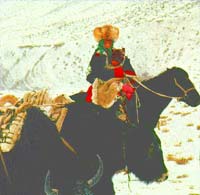
In the Changtang National Reserve,
a Tibetan mother put her baby in the front pocket of her robe.
- Felt
It may snow in any day. To protect oneself, felt hat and felt clothes are necessary. The sleeves of felt clothes are longer than the finger tips which will allow a rider to grasp the whip warmly inside.
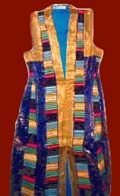
A beautiful Tibetan sleeveless dress. - Hat
There are many different hats in Xizang (Tibet). Traditionally, Tibetans have `golden flowered hat', English felt hat, etc.. In the summer, people wear heavy woollen hat, in the spring, felt hat, in the winter, fox belt hat or kid belt hat. The noble women use to wear a headpieces called `bazhug' which are decorated with pearl, coral and precious stones, and a chest ornament called `keu'. Now they are common.
- Boot
There are many different styles of shoes, `songba', `jialou' and `duozha'. The Tibetan shoes are open from rear and tied from rear. On the grassland, Tibetans like knee-high long boots. It is made of ox skin or `pulu'.
- Apron
It is popular for Tibetan women to wear aprons. There are two kinds of aprons: wide stripes ones and narrow stripes ones. The wide stripes one is with contrast, bright colours, as beautiful as rainbows. The narrow stripes one is with harmonic colours, elegant and graceful.
- Celebration
For the big occasions, Tibetans, men and women alike, dress in purple or green satin gowns, maybe sleeveless, lined either with fur or fabric, all the more resplendent in the sunlight. The men wear their coiled braids high on the head, with red tassels dangling down to the ears. The women wear ornaments of coral and turquoise in their hair, which, together with jewelry and trinkets worn on the chest and around the waist, jingle and tingle pleasantly as they move about. Their floor-sweeping gowns are bell-shaped and elegant. It is a custom for females to wear colourful aprons. Dressed in this fashion, the men appear spruce and smart. Their complexion, attire and bearing give them a statuesque quality. When they are standing in groups of three or four they appear to be clusters of stone sculpture. Tibetans seek beauty in everything while they themselves are a beauty that can hardly be surpassed.