|
Sculpture
 Metal,
clay, stucco, wood, stone, and butter are all used in the creation
of sculptural images. Clay and stucco have been used since
ancient times, particularly in the creation of very large images
installed in monasteries and temples. Wood is also widely used,
intricately carved for entrances to temples and for interior pillars
and in covers for scriptures in monastery libraries. Metal,
clay, stucco, wood, stone, and butter are all used in the creation
of sculptural images. Clay and stucco have been used since
ancient times, particularly in the creation of very large images
installed in monasteries and temples. Wood is also widely used,
intricately carved for entrances to temples and for interior pillars
and in covers for scriptures in monastery libraries.
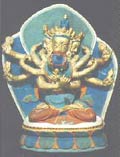
 Tibetan
sculpture, often in the form
of gilt bronze statuettes, consists of slim, elegant figures with
heart-shaped
heads, resembling the Indian Pala or Nepalese figures and frequently
ornamented
with elaborate jewels. Tibetan
sculpture, often in the form
of gilt bronze statuettes, consists of slim, elegant figures with
heart-shaped
heads, resembling the Indian Pala or Nepalese figures and frequently
ornamented
with elaborate jewels.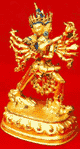 Bronzes are usually made by the 'lost wax process', where a wax
image is created, then coated with a clay based mould which
is subsequently baked allowing the wax to melt and drain away, replacing
it with molten metal. The finished image is often then gilded and
adorned
with
precious and semi precious stones. Metal images are also sometimes
made by the repousse method, where copper, or less commonly silver
or gold, is hammered out into the required shape from the reverse
side.
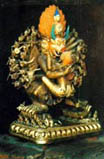
Bronzes are usually made by the 'lost wax process', where a wax
image is created, then coated with a clay based mould which
is subsequently baked allowing the wax to melt and drain away, replacing
it with molten metal. The finished image is often then gilded and
adorned
with
precious and semi precious stones. Metal images are also sometimes
made by the repousse method, where copper, or less commonly silver
or gold, is hammered out into the required shape from the reverse
side.
 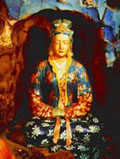
Works of art
are usually commissioned, either by monasteries or lay patrons,
and their execution generally follows strict canonical rules as
to proportions, symbols and colors, in accordance with artistic
manuals.
Tibetan art
is largely anonymous, and this custom of artistic anonymity is grounded
in the Buddhist belief in working toward the elimination of the
individual ego. The Tibetan attitude to a work of art is that when
it is successfully completed it has an existence of its own and
an inherent power to help the viewer come to spiritual realization.
It ceases to be the property of the artist when it leaves his studio.
|