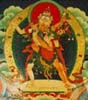
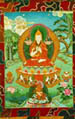
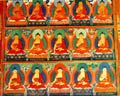
Painting Rich and varied color is the most striking feature of Tibetan painting. The painting medium best known outside Xizang (Tibet) is the Thangka, or scroll painting. The central figures of Thangkas may follow Nepalese or Indian types, but their decorative details, such as cloud scrolls, flowers, and architectural motifs, are often of Chinese origin. It is difficult to date these paintings, since the text, canons of proportion, and technical rules for making them have been almost unvaried for centuries. The symbolism is highly complex. Strongly schematized paintings portray ritual diagrams, scenes of the pantheon of divinities, and the wheel of life. Usually painted on cotton cloth, more rarely on silk, colors are traditionally made from minerals as well as vegetable dyes. Before application, they are de-saturated in varying degrees in lime and mixed with boiled gum Arabic. These 'stone' colors maintain their intensity so well that many old Thangkas still retain striking colors. Today, Tibetan artists also use modern synthetic dyes. Thangkas are traditionally mounted in frames of silk brocade with a pole or batten at the top and bottom so that it can be easily hung. Since it is also easily rolled up, the thangka can be stored away or readily transported from one place to another. Itinerant lamas used them as icons of personal devotion and to sanctify tents in which they held teachings of Buddhist doctrine. They are also used as effective teaching aids. In most Tibetan homes the thangka, together with small bronze images, is an integral part of the family altar and a vehicle of visual dharma. Besides Thangkas, Xizang (Tibet) also has other 2-dimensional painting such as Fresco, Wooden Tablet and Sand Painting.
|