|
Music
Music plays
an important part in Tibetan
life and has three aspects:
-
Sacred
chant and instrumental music of the Buddhist Liturgy and other
rites: centered on the monasteries. The Lamas claimed "Religion
is sound". The recitation of mantras, chanting and the playing
of instrumental music are fundamental in their worship. The red-robed
monks intone their prayers, sitting cross-legged under the soft
light of butter-lamps. The chants are sometimes free but more
usually metrical, in both symmetrical and asymmetrical measures.
The voice-style, which is close-throated or constricted and usually
very deep in pitch, is unnatural. Instead, it is deliberately
cultivated style.

rGaling |

Dung |
Tonally
speaking, the chanting varies from an inflected monotone to a
melodic pattern, and is decorated in a variety of ways,
especially by glottal slides up to or down to a note, or down
from a note. A traditional notation exits
for the chants.
Chanting is
sometimes unaccompanied, but is more usually accompanied by an
ensemble, amounting to an orchestra (passim). This orchestra consists
exclusively of wind instruments - always played in pairs - and
percussion instruments of indefinite pitch. There are no stringed
instruments, which are found only in the secular music.
- Folk-music:
found in the daily lives of the people
- Art music:
cultivated especially by professional minstrels
Wind Instruments
and their sounds
- rGaling
- Dung
- Dung-dkar
- rKangling
Percussion
Instruments of Indefinite Pitch and their sounds
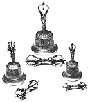
- Drilbu
- Damaru
- Rolmo
- Silnyen
- rGna
Percussion
Instruments of Definite Pitch and their sounds
- mkar-rnga
- Ting-ting
The Ensemble
and its sound
Voices and instruments occur together
|
|