|
Dance
Tibetans dance
in different festivals, and for different purposes. For instance,
they play music and dance for healing. Buddhists give music-and-dance
offerings because they please the deities' senses. Student monks
will soothe the gods (and invoke good health) by murmuring sacred
chants to the steady beat of drums and other instruments. Here are
other examples:
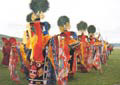
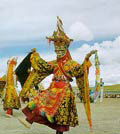
- Sha-nak
Gar-cham: Dance of the Black Hat Masters
This
ancient dance for the elimination of negative energies and hindrances
is in the style known as drak-po, or "wrathful." The implements
held by the dancers symbolize the transcendence of false ego-identification
on the outer (the environment), inner (the emotions), and the
secret (the subtle body-mind link) levels. Their movements symbolize
the joy and freedom of seeing reality in its nakedness.
- Kha-dro
Ten-shug Gar-cham: Dance of the Celestial Travelers
Five dancers, symbolizing the five elements and five wisdoms,
together with three musicians, invoke the sounds and movements
of the Celestial Travelers, the mystical beings from another world
whose blessings strengthen the forces of life and light. These
beings visit our world in times of stress and danger, bringing
with them the creative energy that inspires harmony and peace.
- Yak-cham:
The Yak Dance
When the human world enters into a mode of balanced and wholesome
living, all life forms rejoice, including those of the animal
kingdom. This is here represented by the ecstatic dance of the
yak, the animal unique to Central Asia and symbolic of the Tibetan
spirit of rugged strength and playfulness.
- Dur-dak
Gar-cham: Dance of the Skeleton Lords
To remind the world of the ephemeral nature of all things, and
of the liberating and balancing impact of an awareness of this
reality, two monks appear as the forces of goodness manifest as
Cemetary Lords. These are Dharmapala, or "Protectors of Truth,"
with the message to point the mind toward authentic being.
- Seng-geh
Gar-cham: The Snow Lion Dance
In Xizang (Tibet) the snow lion symbolized the fearless and elegant quality
of the enlightened mind. When a healthy and harmonious environment
is established by the creative activities of human beings, such
as through the performance of sacred purification and healing
music, all living beings, here represented by the snow lion, rejoice.
|
|